
How to Evaluate a Supplier's Allergen Labelling: Evidence, Not Assurances
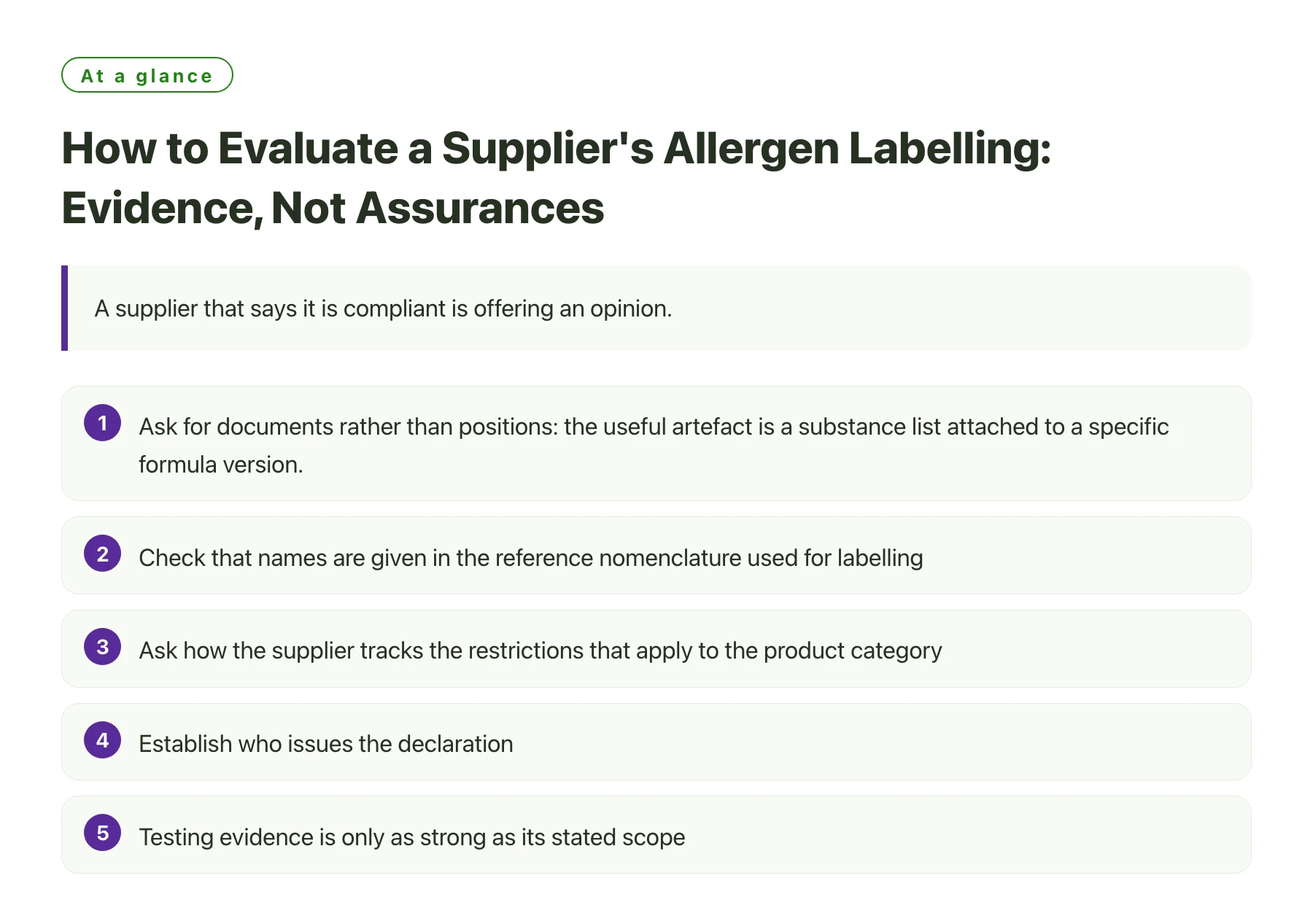
A supplier that says it is compliant is offering an opinion. A supplier that can produce a substance list tied to a formula version, in reference nomenclature, on a named date, is offering evidence. The difference matters most on a value line, where supplier changes are common and reprints are frequent, and where an unverifiable declaration becomes an expensive problem only after the cartons are printed. This scorecard turns that distinction into questions a buyer can ask in a single meeting.
Key takeaways
- Ask for documents rather than positions: the useful artefact is a substance list attached to a specific formula version.
- Check that names are given in the reference nomenclature used for labelling, because reviewers compare names literally rather than interpretively.
- Ask how the supplier tracks the restrictions that apply to the product category, since fragrance materials are governed by industry standards as well as local cosmetics rules [1].
- Establish who issues the declaration, how quickly, and what happens if the compound changes after it is issued.
- Testing evidence is only as strong as its stated scope, so the question is what was tested and on which pack rather than which laboratory stamped the page [2].
- A supplier that cannot describe its own process is not a supplier that will pass an audit; process description is the cheapest available proof.
Allergen labelling is a documentation problem disguised as a technical one. The technical part, checking concentrations against thresholds, is well defined. The difficulty is that the information lives in several places: the fragrance compound, the finished formula, the pack and the label artwork, each held by a different party.
This scorecard is written for the buyer evaluating a candidate manufacturer, not for the compliance specialist writing the final file. Its purpose is to separate suppliers that can support a label from suppliers that can only produce the product.
Six questions and how to read the answers
| Question | A strong answer | A weak answer |
|---|---|---|
| How do you produce the allergen declaration for a formula? | A named process, a document template and a stated turnaround time | "Our compound supplier handles that" with no named contact or format |
| In what form does the substance list arrive? | Reference names, concentrations or threshold flags, tied to a formula version | A trade-name list in an email, or a copy of a previous product's label |
| How are material restrictions tracked? | A documented review against the standards and rules that apply to the category | An assurance that the compound is already compliant |
| What happens if the compound changes? | A re-issue process with a version stamp and notification to the brand | A verbal note that the change is minor |
| Which tests support the pack? | Reports naming the formula version, container, closure and storage conditions | A generic compatibility statement with no pack named |
| Who answers a regulator's question in year two? | A named role and a retained record of the batch and formula versions | "We can look into it if it happens" |
| Can you show one anonymised example? | A redacted sample declaration that demonstrates the format | Refusal on the grounds that all client work is confidential |
Score the answers rather than the delivery. Two strong answers and one process description are worth more than seven assurances.
Why this evaluation is harder on a value line
Value lines put pressure on exactly the controls that allergen labelling depends on. They change suppliers for cost reasons, they refresh packaging more often, and they often run smaller batches with shorter notice. Each of those movements is reasonable in isolation and together they make a declaration harder to keep current.
The buyer's response should be procedural rather than distrustful. Ask each candidate how it handles a formula change after a declaration has been issued, and ask to see the version stamp. A supplier that answers with a document is describing a habit; a supplier that answers with a promise is describing an intention.
It is also worth asking who on the supplier's side owns the declaration, and whether that person is in quality, regulatory or development. The department matters less than the fact that a person is named, because documents without owners are the ones that go stale. A question about ownership is also a fair test of how the factory is organised, in the same way that a buyer would use due diligence on a perfume manufacturer to test technical claims.
Where the supplier is a Chinese manufacturer selling into several markets, ask specifically how it handles market differences. The same compound may need different label text, and the supplier's ability to keep those variants apart is a good indicator of whether its documentation is systematic. A factory that presents itself as a Chinese factory for perfume brands is making a claim about serving brand requirements rather than only producing volume, and allergen documentation is one of the places where that claim is either supported or not.
What to check when the answers are vague
Vagueness has a pattern, and it is usually a mixing of two different questions: whether the compound complies with a set of restrictions, and whether the finished product's label declares the right substances. A supplier may be truthful about the first and unprepared for the second, because the second depends on the brand's formula, pack size and market as well as on the concentrate.
When the distinction is unclear, ask the supplier to walk through one example end to end: a compound, its documentation, the finished formula, the resulting declaration and the label text. A supplier that can narrate that chain without leaving gaps has the process. A supplier that can only describe its certificates has the paperwork.
It is worth pursuing one further question about the fragrance itself: which materials in the proposed composition are subject to use restrictions in the target category, and how the compound is verified against them. Fragrance materials are governed by industry standards that set use limits by product type, and the review is expected to happen before the formula is locked rather than after the label is drafted [1].
The testing side deserves the same scrutiny. A compatibility or stability report answers a question only if the question is stated: which formula, which bottle, which closure and which storage conditions. Reports that name those four elements are usable evidence; reports that omit them are pages that will have to be replaced at the worst possible moment [2].
Finally, test the supplier's willingness to be checked. A manufacturer that offers a redacted example of its declaration format, or that invites an audit of its documentation flow, is demonstrating confidence in its own process. That confidence is worth more than another certificate list, and it is much harder to fake than an assurance. A question put to the perfume factory in Guangzhou that quoted you, for instance, is not whether the factory holds certificates, but whether it can produce the declaration for your formula in a week and explain how it was derived.
One practical rule for comparing candidates: give each supplier the same formula placeholder and ask what it would return, in what format, and in how many working days. A supplier that responds with a sample document moves to the shortlist. A supplier that responds with a promise stays where it is until it does.
Sources
- IFRA Standards Library (International Fragrance Association) —— The IFRA Standards Library lists the restrictions the fragrance industry applies to individual fragrance ingredients, based on safety assessments; it is the reference point for compliant fragrance formulation.
- SGS: Cosmetics, Personal Care & Household Testing —— Testing, inspection and certification services for cosmetics and personal care, including microbiological, stability and safety testing aligned with cosmetics GMP.
Frequently asked questions
What document should a buyer expect for allergen labelling?
A substance list in reference nomenclature, tied to a specific formula version, showing concentrations or threshold flags for the product type. Ideally it carries a date and a version reference, and the supplier can re-issue it when the formula changes.
Is a compliance certificate enough to show allergen labelling is handled?
No. A certificate describes a site or a management system. Allergen labelling depends on the specific formula, pack and market, so the evidence has to be product-specific even when the supplier's systems are certified.
How can a buyer tell whether testing reports are useful?
Check whether the report names the formula version, the container, the closure and the storage conditions. Without those four, the report cannot be tied to the product being sold, and it will not support a label review.
Should a value line use the same supplier for the compound and the finished product?
Not necessarily, but the documentation responsibility has to be explicit. If the compound and the filling are handled by different companies, one of them must own the declaration and pass it to the brand, and that arrangement should be written into the order terms.
How often should a supplier's allergen documentation be re-checked?
Whenever the formula, the pack, the supplier or the destination market changes, and periodically in between. The trigger-based check is the one that prevents a reprint, while the periodic check catches regulatory changes.
Plan a wedding that actually looks like you.
4,217 vetted independent vendors across all 50 states. No beige. No clichés. Just the people who get it.
Find Your Vendors